
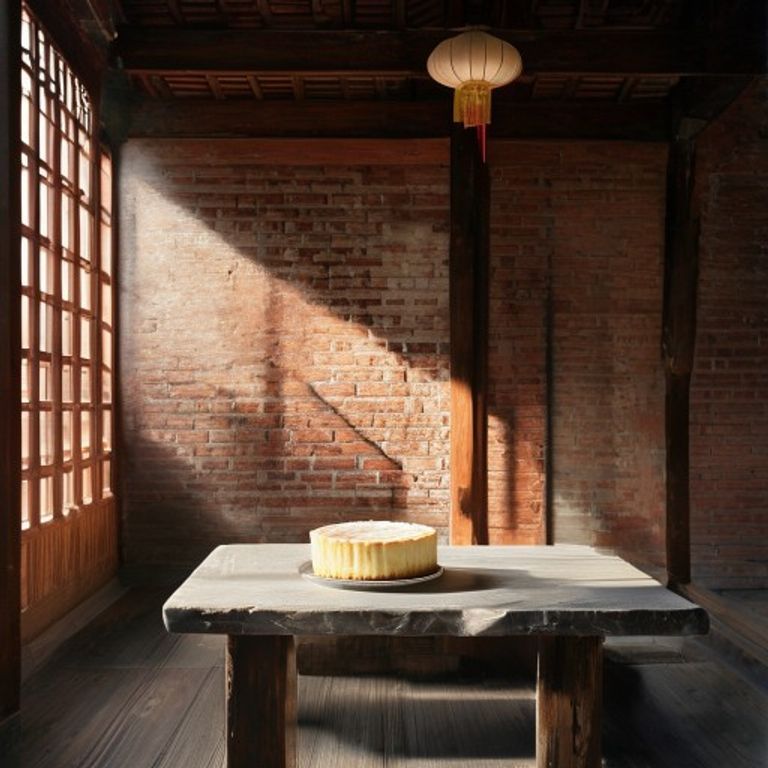

彰化三合院的午後,陽光透過木格窗,在磨石子地板上畫出幾何圖案。我坐在烤箱旁,感受著熱氣的溫柔包圍,像極了這老屋厚實紅磚牆所提供的恆定庇護。指尖輕觸牆面,那股沉穩的涼意,彷彿能將外界的喧囂悉數吸收,只留下內在的寧靜。這份穩定,讓我想起了甜點烘焙中最核心的科學概念——熱平衡。
In the afternoon at the Sanheyuan in Changhua, sunlight streams through wooden lattice windows, painting geometric patterns on the polished stone floor. I sit by the oven, enveloped by its gentle warmth, much like the constant shelter provided by the old house’s thick red brick walls. My fingertips trace the wall’s surface; that steady coolness seems to absorb all external clamor, leaving only an inner tranquility. This stability reminds me of a core scientific concept in dessert baking—thermal equilibrium.
一、 熱平衡的智慧:為何古宅能恆定歲月與心緒?
I. The Wisdom of Thermal Equilibrium: Why Do Ancient Homes Stabilize Time and Temperament?
熱平衡,在物理學中指的是系統內外或各部分之間,熱量傳遞達到一種沒有淨熱流動的狀態。這座三合院,便是「熱平衡」的最佳實踐者。它厚重的紅磚與木結構,擁有極高的比熱容(specific heat capacity)與適中的導熱係數(thermal conductivity $\kappa$)。這使得它能緩慢地吸收白天的熱量,再溫柔地釋放於夜間;反之,也能在酷暑中保持相對涼爽,在嚴冬裡維持一份暖意。它不追求瞬間的改變,而是以時間為介質,達到一種深沉而持久的恆定。
Thermal equilibrium, in physics, refers to a state where there is no net flow of heat within or between parts of a system. This Sanheyuan is the perfect embodiment of